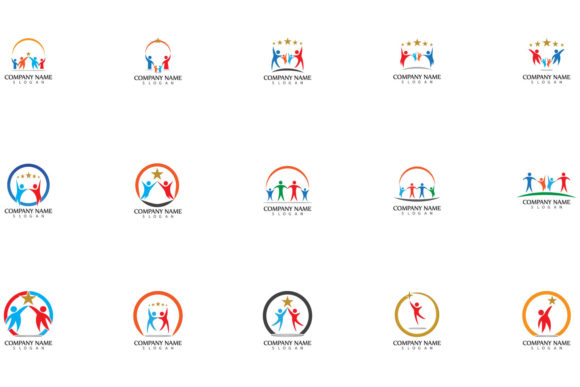
People Icon Work Group Vector Logo Design: Visualizing Modern Collaboration
In the digital landscape, where attention spans are fleeting and visual communication is paramount, the People Icon Work Group Vector Logo Design serves as a critical bridge between abstract corporate concepts and human connection. This specific category of graphic design transcends simple decoration; it functions as a universal language that instantly communicates teamwork, organization, and social structure. For professionals ranging from startup founders to seasoned marketing directors, understanding the nuance of these symbols is essential for building brands that resonate with contemporary audiences. The evolution of the people vector has mirrored shifts in workplace culture, moving from rigid hierarchical representations to fluid, inclusive illustrations that reflect the reality of modern collaboration.
The Evolution of Human Symbolism in Business Graphics
Historically, business iconography relied heavily on literal interpretations of the workforce. Early depictions often featured detailed silhouettes of men in suits or generic stick figures that lacked personality and diversity. These images served a functional purpose but failed to capture the emotional or dynamic nature of partnership and leadership. Today, the demand for a sophisticated people icon stems from a need to represent complex social dynamics within a simple pictogram. Modern design trends have shifted toward abstraction and inclusivity, acknowledging that a team is no longer defined by uniformity but by the synergy of diverse members.
This shift is evident in how designers approach the human symbol. Rather than focusing on anatomical correctness, current illustrations prioritize gesture, proximity, and negative space to convey communication and unity. A well-executed people vector does not merely show three individuals standing next to each other; it illustrates the invisible threads of connection that define a successful organization. This evolution aligns with broader societal changes regarding gender, race, and professional roles, making the modern people team graphic a reflection of progressive values rather than just a stylistic choice.
Why Vector Format Remains the Industry Standard
When discussing logo design and web graphics, the technical foundation is as important as the aesthetic. The term "vector" in People Icon Work Group Vector Logo Design refers to a mathematical method of rendering graphics that ensures infinite scalability without loss of quality. Unlike raster images composed of pixels, vectors maintain crisp edges whether they are displayed as a tiny button on a mobile app or blown up across a convention center banner. For businesses and creators, this versatility is non-negotiable.
The practical implications of using vector formats extend beyond mere resolution. Vectors allow for effortless customization, enabling designers to adjust colors, stroke weights, and compositions to match specific brand guidelines. A black silhouette might work perfectly for a minimalist print campaign, while a vibrant, multi-colored version of the same people icon could be more appropriate for a tech startup’s website header. Furthermore, vector files are typically lightweight, contributing to faster load times on websites and smoother performance in digital presentations. In an era where user experience is directly tied to site speed and visual clarity, the technical superiority of the people vector is a strategic asset.
Communicating Leadership and Partnership Through Simplicity
Simplicity in design should never be mistaken for a lack of depth. On the contrary, creating a simple yet meaningful representation of a work group requires a profound understanding of visual semiotics. When a user encounters a people icon, they process the information in milliseconds. The brain must instantly categorize the image as representing staff, community, or leadership. Effective design leverages familiar shapes and spatial relationships to trigger these associations without cognitive friction.
- Proximity and Overlap: Placing figures close together or overlapping their outlines suggests intimacy, trust, and active collaboration. Separated figures may imply independence or distinct departments within an organization.
- Scale and Hierarchy: While modern design often favors egalitarian sizing to represent flat organizational structures, subtle variations in scale can still effectively denote a manager or leader without resorting to outdated power dynamics.
- Color Psychology: The choice between black, white, or colored silhouettes carries weight. Black and white offer high contrast and neutrality, suitable for formal contexts, while color introduces emotion and brand identity into the concept of teamwork.
- Gender and Diversity Cues: Abstract shapes allow for gender-neutral representations that focus on the role of the person rather than biological characteristics, supporting inclusive messaging in public and corporate sectors.
These elements combine to form a sign system that speaks to both the logical and emotional sides of the viewer. A graphic that successfully balances these factors becomes more than an illustration; it becomes a trusted marker of organizational competence and social awareness.
Practical Applications Across Digital and Print Media
The utility of a robust people team asset library extends across virtually every touchpoint of modern business communication. For web designers, these icons serve as intuitive navigation aids, guiding users to "About Us," "Team," or "Contact" pages without relying solely on text. In the context of infographics, people vectors transform dry data about employee satisfaction or demographic breakdowns into engaging visual narratives. They provide a human anchor for statistics, making abstract numbers feel relevant to the reader’s lived experience.
Beyond the screen, these symbols play a vital role in physical environments and printed collateral. Office signage utilizes clear, universally understood pictograms to direct visitors and employees, reducing confusion in large facilities. Business cards and brochures use stylized group illustrations to reinforce brand identity and convey company size or culture at a glance. For educators and trainers, these graphics are indispensable tools for creating presentation slides that illustrate concepts like conflict resolution, project management, or social networking. The adaptability of the people icon makes it a cornerstone of visual literacy in professional settings.
Selecting the Right Style for Your Organizational Identity
Not all people icons are created equal, and selecting the wrong style can create dissonance between your message and your visual identity. A law firm might opt for solid, stable silhouettes in dark tones to convey reliability and tradition. Conversely, a creative agency or software company might choose line art or geometric abstractions to signal innovation and flexibility. Understanding the connotations of different artistic styles is crucial for effective communication.
- Line Art and Outlines: These convey openness, modernity, and transparency. They are excellent for tech companies and startups wanting to appear accessible and forward-thinking.
- Solid Silhouettes: Bold and authoritative, these are best for established institutions, government bodies, or organizations emphasizing strength and unity.
- Geometric Abstraction: Using circles and curves to suggest human forms removes specific identity markers, focusing entirely on the concept of connection. This is ideal for global organizations needing culturally neutral imagery.
- Detailed Illustration: While less common for logos, detailed character designs work well for mascots or specific storytelling campaigns where individual personality matters more than collective symbolism.
Creators must also consider the background context. A white icon on a dark interface creates a sleek, premium feel, while a black icon on white ensures maximum legibility for accessibility compliance. Testing these variations in real-world scenarios is the only way to ensure the chosen symbol performs its intended function effectively.
Ethical Considerations and Inclusivity in Representation
As visual communicators, we bear a responsibility to ensure our symbols reflect the world as it is and as we aspire it to be. The era of the generic male businessman as the default representation of work is over. Modern People Icon Work Group Vector Logo Design must actively embrace diversity not as a trend, but as a baseline standard. This goes beyond simply adding female figures to a group; it involves considering age, ability, and cultural markers in ways that feel authentic rather than tokenistic.
Inclusivity also intersects with accessibility. High-contrast designs are not just an aesthetic preference; they are a requirement for users with visual impairments. Ensuring that icons are distinguishable for colorblind users and recognizable at small sizes guarantees that your communication reaches the widest possible audience. Furthermore, avoiding stereotypical poses or roles helps dismantle unconscious biases. A people team graphic should empower every member it represents, reinforcing the idea that leadership, innovation, and collaboration are human traits, not demographic ones.
Future-Proofing Your Visual Assets
Trends in graphic design are cyclical, but the fundamental need to represent human connection remains constant. To future-proof your investment in people vector assets, prioritize timelessness over novelty. Avoid hyper-stylized effects that date quickly, such as heavy gradients or skeuomorphic details. Instead, focus on strong foundational geometry and balanced proportions that will remain relevant as design fashions shift.
Additionally, maintain organized source files. As your organization grows or pivots, you may need to adapt your existing people icon to reflect new team structures or brand updates. Having clean, layered vector files allows for rapid iteration without the cost of commissioning entirely new artwork. Treat your iconography as a living system rather than a static deliverable. By doing so, you ensure that your visual language continues to support your mission, fostering a sense of belonging and purpose among your staff, clients, and community.
Ultimately, the power of the People Icon Work Group Vector Logo Design lies in its ability to distill the complexity of human interaction into a singular, potent mark. Whether used to signify a massive corporation or a small partnership, these symbols remind us that behind every business metric and digital interface, there are people working together to create value. Mastering this visual vocabulary is not just about making things look good; it is about making organizations feel human in an increasingly automated world.