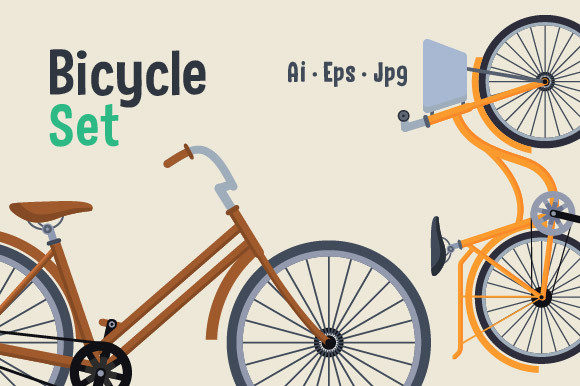
Bicycle Set: Integrating Scalable Vector Illustrations into Professional Workflows
In the landscape of modern digital design and content creation, efficiency often dictates quality. For professionals managing tight deadlines across multiple platforms, the Bicycle Set serves as more than just a collection of thematic graphics; it is a functional asset library designed to streamline visual communication. This comprehensive collection of 100 vector illustrations provides a cohesive visual language that can be deployed across presentation slides, print templates, web graphics, icons, infographics, and game assets. Understanding how to integrate this resource effectively requires looking beyond the aesthetic appeal and focusing on technical compatibility, workflow integration, and long-term asset management.
Technical Foundation and Format Compatibility
The core value of the Bicycle Set lies in its vector architecture. Unlike raster images that degrade when scaled, these 100 illustrations are built on mathematical paths, allowing for infinite resizing without quality loss. This technical characteristic is fundamental for professionals who must repurpose a single asset for vastly different outputs. A bicycle icon used as a 32-pixel favicon on a website must retain the same crispness when blown up to cover a billboard or a trade show banner. The included AI and EPS files ensure this scalability, while the JPG versions provide immediate utility for non-editable contexts.
When incorporating this set into your production pipeline, verify your software environment first. The AI file format is native to Adobe Illustrator, making it the primary source for editing colors, stroke weights, and composition. However, the EPS format acts as the universal bridge for cross-platform compatibility. If your team uses Affinity Designer, CorelDRAW, or open-source alternatives like Inkscape, the EPS files will maintain their vector integrity. Before beginning any project, import a test file to confirm that gradients and complex paths translate correctly within your specific software ecosystem. This preliminary check prevents mid-project friction and ensures that the "resize without losing quality" promise holds true for your specific tools.
Strategic Application Across Project Phases
The versatility of the Bicycle Set allows it to function at various stages of the creative and business lifecycle. Its application extends far beyond simple decoration, serving as a structural element in communication strategies.
Pre-Production and Concepting
During the planning phase of a campaign or product launch, visual consistency is often established before final copy is written. The Bicycle Set can serve as a rapid prototyping tool. Instead of spending hours sketching custom metaphors for movement, progress, or eco-friendly initiatives, designers can pull relevant vectors to populate wireframes and mood boards. This accelerates stakeholder approval by providing tangible visuals early in the decision-making process. For educators and trainers, this phase involves mapping curriculum concepts to specific icons, ensuring that the visual aids align with learning objectives before slide decks are finalized.
Active Production and Asset Deployment
Once a project moves into execution, the organized nature of a 100-piece set becomes a productivity multiplier. In web design, these vectors can be exported as SVGs for lightweight, responsive interface elements. For print designers working on brochures or packaging, the high-resolution vectors ensure sharp output at any DPI. Game developers can utilize the assets as UI elements or environmental props, leveraging the consistent line weight and style to maintain immersion. Crucially, because the set shares a unified design DNA, mixing and matching different bicycles or accessories does not create visual dissonance. This inherent consistency reduces the time spent on color correction and style matching, allowing creators to focus on layout and messaging.
Post-Project Archiving and Repurposing
After a project concludes, the Bicycle Set facilitates efficient archiving and future reuse. Because the assets are standardized, they can be tagged and stored in digital asset management (DAM) systems alongside other brand resources. When a similar project arises six months later, there is no need to source new imagery or recreate existing styles. The previous work serves as a foundation, drastically reducing turnaround times for iterative campaigns or seasonal updates.
Workflow Integration and Tool Interoperability
Seamless integration requires understanding how the Bicycle Set interacts with broader design ecosystems. These vectors are rarely used in isolation; they are components of larger compositions involving typography, photography, and data visualization.
- Color Management: Vector files allow for global color changes. Establish a master swatch library based on your brand guidelines before modifying individual assets. This ensures that every bicycle illustration pulled from the set adheres to current corporate identity standards without manual hex code entry.
- Layer Organization: Professional vector files should have logical layer structures. When integrating these assets into complex layouts, keep them on separate layers or smart objects. This non-destructive workflow allows you to toggle visibility, adjust opacity, or apply effects without altering the original source geometry.
- Cross-Platform Exporting: Create export presets for common use cases. For web teams, an SVG preset optimized for file size is essential. For print vendors, a PDF/EPS preset with outlined fonts and embedded profiles prevents prepress errors. Automating these exports saves significant time when delivering assets to diverse stakeholders.
- Collaboration Handoffs: When sharing files with clients or external partners who may lack vector editing software, always include the JPG versions as reference thumbnails. This prevents confusion and ensures that feedback cycles remain focused on creative direction rather than technical troubleshooting.
Practical Implementation Tips for Consistency
Achieving professional results with the Bicycle Set depends on disciplined implementation. While the assets are ready to use, thoughtful adaptation elevates the final output. Consider the context of scale and negative space. A detailed bicycle illustration that looks stunning on a poster may become illegible noise when reduced to a mobile app button. Test assets at their intended display size during the design phase, not just at the end. Simplify or remove internal details for smaller applications to preserve clarity.
Consistency also applies to stylistic treatment. If you apply a drop shadow or gradient overlay to one vector in the set, apply the same treatment to all related vectors in that specific project. Visual cohesion builds trust with the audience. For infographics, use the bicycles as directional cues or data markers rather than mere decoration. The orientation of the vehicle can guide the viewer’s eye through the information hierarchy, turning a static image into a functional navigation element.
For entrepreneurs and small business owners creating their own marketing materials, resist the urge to over-customize. The strength of a curated set like this is its professional finish. Minor adjustments to color are usually sufficient to make the asset feel bespoke. Extensive reshaping or redrawing can introduce inconsistencies that undermine the premium feel of the collection. Trust the original design intent unless a specific functional requirement demands alteration.
Quality Control and Long-Term Asset Management
Maintaining the integrity of the Bicycle Set over time requires proactive organization. Upon purchase, immediately organize the files into a structured directory system. Separate source files (AI/EPS) from delivery formats (JPG/SVG). Rename files descriptively if the default naming convention does not match your internal taxonomy. For example, renaming "bike_045.eps" to "mountain-bike-side-view.eps" improves searchability and reduces retrieval time during high-pressure moments.
Regularly audit your usage of the set to identify gaps or redundancies. If you find yourself repeatedly modifying the same base vector for a specific recurring need, consider saving that modified version as a new master asset within your local library. This evolves the purchased set into a customized toolkit tailored to your specific operational needs. Conversely, if certain assets never see use, archive them to keep your active workspace uncluttered.
Compatibility checks should be performed periodically, especially after software updates. Vector rendering engines change, and an effect that worked perfectly in last year’s version of Illustrator might render differently today. Keeping a "known good" export of critical assets serves as a safety net against software-induced regression. This attention to technical maintenance ensures that the Bicycle Set remains a reliable component of your creative infrastructure for years to come.
Maximizing Value Through Intentional Use
The Bicycle Set represents a strategic investment in visual efficiency. By treating these 100 vectors as modular building blocks rather than static pictures, professionals can unlock significant workflow advantages. The ability to resize without quality loss addresses the multi-format reality of modern media, while the inclusion of AI, EPS, and JPG formats covers the spectrum from deep editing to quick deployment. Success with this resource comes from preparation, systematic organization, and a clear understanding of how vector assets support broader communication goals. Whether enhancing a corporate presentation, developing a game interface, or designing educational materials, the disciplined application of this collection transforms generic graphics into powerful, scalable tools for visual storytelling. Happy designing and happy purchasing stem not just from acquiring assets, but from mastering their integration into a sustainable, high-quality creative process.