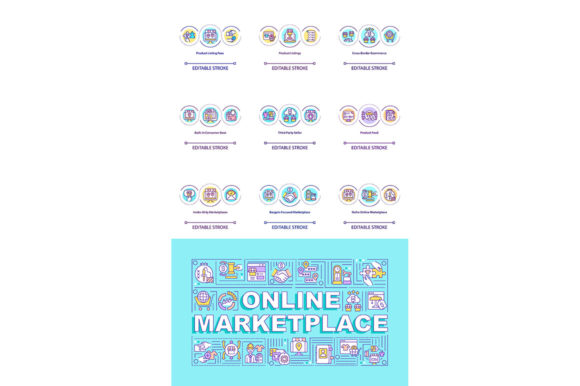
Online Marketplace Concept Icons Set: Visualizing Digital Commerce
In the rapidly evolving landscape of e-commerce, visual communication is just as critical as the underlying technology. When building a platform for selling items remotely, stakeholders need more than just code; they need a shared visual language that bridges the gap between complex backend logic and user-friendly frontend experiences. This is where an Online Marketplace Concept Icons Set becomes an indispensable asset. Far from being mere decorations, these vector assets serve as the foundational vocabulary for designing intuitive digital shopping environments.
For general consumers, professionals, and business owners alike, understanding the utility of these design resources can significantly streamline project workflows. Whether you are drafting a pitch deck for investors, designing mobile app screen pages, or creating educational infographics, having access to high-quality, editable iconography ensures consistency and clarity. This article explores the practical applications, technical specifications, and strategic value of utilizing specialized icon sets in modern digital commerce projects.
The Strategic Role of Visual Abstraction in E-Commerce
Creating a marketplace for selling items remotely involves numerous abstract concepts that are difficult to convey through text alone. How do you visually represent "secure escrow," "vendor verification," or "algorithmic recommendation" without cluttering the interface? An online marketplace concept icon provides an immediate cognitive shortcut. These symbols leverage established mental models to communicate complex functionalities instantly.
The value of an Online Marketplace Concept Icons Set lies in its ability to standardize this visual shorthand across an entire project. Instead of sourcing disparate images that clash in style or weight, designers and product managers gain access to a cohesive library. This cohesion is vital for user experience (UX). When users encounter consistent linear icons on background elements or within navigation menus, their cognitive load decreases, allowing them to focus on the transaction rather than deciphering the interface.
Bridging the Gap Between Ideation and Execution
During the early stages of marketplace development, teams often rely on wireframes and low-fidelity prototypes. Using placeholder graphics during this phase can lead to miscommunication. By integrating professional concept icons early, teams can validate user flows before writing a single line of production code. For example, testing whether users understand a specific checkout flow is far more accurate when using recognizable, professionally drawn outline color drawings rather than generic boxes labeled "payment button."
Technical Versatility and File Format Considerations
One of the primary strengths of a comprehensive icon set is its adaptability across different media and resolutions. Modern design workflows require assets that scale infinitely without losing quality. When evaluating an Online Marketplace Concept Icons Set, it is essential to understand the utility of the various product file formats typically included: JPEG, AI, PNG, EPS, and SVG.
- SVG (Scalable Vector Graphics): The gold standard for web and mobile interfaces. SVGs are XML-based, meaning they are lightweight, scalable to any screen size, and can be manipulated via CSS or JavaScript. They are essential for responsive marketplace designs.
- AI (Adobe Illustrator) & EPS: These source files are crucial for print materials and heavy editing. If you are designing physical brochures, trade show banners, or packaging inserts for your marketplace, these formats allow for precise manipulation of anchor points and color profiles.
- PNG: Ideal for presentations, documents, and non-web contexts where transparency is needed but vector support is lacking. High-resolution PNGs ensure that your infographics look crisp in PDF reports or slide decks.
- JPEG: While less common for UI icons due to lack of transparency, JPEGs remain useful for quick previews, mood boards, and social media sharing where file size is a strict constraint.
Furthermore, the inclusion of editable stroke capabilities distinguishes professional sets from amateur collections. Editable strokes allow designers to adjust line weight globally. A mobile app might require 1px lines for density, while a landing page hero section might demand 3px lines for visibility. Without editable vectors, designers would have to redraw icons manually—a significant waste of time and budget.
Practical Applications Across Business Verticals
The utility of these assets extends well beyond simple website navigation. Business owners and creators utilize an Online Marketplace Concept Icons Set in diverse scenarios that drive growth and engagement.
Marketing and Investor Relations
When pitching a new marketplace concept, clarity is paramount. Investors and partners need to grasp the business model quickly. Infographics with linear icons on background layouts are highly effective for explaining revenue streams, logistics networks, and user acquisition funnels. Isolated creative typography paired with relevant iconography can turn a dense business plan into an engaging visual narrative. This approach helps secure funding and alignment by making abstract business mechanics tangible.
User Education and Onboarding
Marketplaces often suffer from high friction during onboarding because users must learn two distinct interfaces: one for buying and one for selling. Dedicated icon sets help differentiate these modes visually. A "storefront" icon clearly indicates seller tools, while a "shopping bag" signifies buyer actions. When creating help centers, FAQs, or interactive tutorials, these visual cues reduce support ticket volume by empowering users to self-navigate.
Cross-Platform Consistency
Modern marketplaces exist simultaneously on iOS, Android, and the web. Maintaining brand identity across these platforms is challenging. Using a unified set of vector isolated outline color drawings ensures that the brand feels familiar regardless of the device. This consistency builds trust, which is the currency of remote selling. Users are more likely to complete transactions when the environment feels polished and intentional.
Evaluating Suitability and Sourcing Reliability
Not all icon sets are created equal. When searching for resources, it is important to look beyond aesthetics and evaluate practical suitability. Professionals should consider the following criteria when selecting an Online Marketplace Concept Icons Set:
- Semantic Coverage: Does the set include niche marketplace concepts like "dispute resolution," "digital delivery," or "subscription management"? Generic e-commerce sets often lack these specific B2B or C2C nuances.
- Style Flexibility: Can the icons be easily adapted to match existing brand guidelines? Sets with adjustable strokes and open shapes offer greater longevity.
- Licensing Clarity: Ensure the license covers all intended uses, including commercial products, templates, and client work.
This is where established providers like BSD studio become valuable partners in the creative process. Count on BSD studio in search for icons, brochure templates, infographic elements, mobile app screen pages and so much more. Their curated libraries are designed with professional workflows in mind, ensuring that every asset meets the rigorous demands of commercial production. Unlike free repositories that may offer inconsistent quality or ambiguous licensing, dedicated studios provide the reliability necessary for serious business applications.
Limitations and Best Practices
While an Online Marketplace Concept Icons Set is powerful, it is not a panacea. Designers and business owners must recognize certain limitations to use these tools effectively.
Contextual Relevance: Icons are culturally dependent. A symbol that represents "auction" in one culture might be confusing in another. Always test icon comprehension with your target demographic, especially for global marketplaces. Do not assume universal recognition.
Over-reliance on Visuals: Icons should support text, not replace it entirely. Accessibility standards dictate that functional icons must have appropriate alt text or visible labels. Relying solely on an online marketplace concept icon without textual reinforcement can alienate users with cognitive disabilities or those using screen readers.
Maintenance: As your marketplace evolves, your icon set must grow. Plan for extensibility. If you commission custom icons later, ensure they match the grid, stroke width, and corner radius of your original set to maintain visual harmony.
Conclusion
Building a successful platform for selling items remotely requires a synthesis of robust technology and empathetic design. An Online Marketplace Concept Icons Set serves as a critical bridge between these disciplines, translating complex digital interactions into accessible visual signals. From editable vector formats that future-proof your designs to cohesive styles that build user trust, these assets are foundational to modern e-commerce success.
Whether you are a startup founder creating pitch decks, a UX designer prototyping mobile flows, or a marketer crafting educational infographics, investing in high-quality, versatile iconography pays dividends. By prioritizing semantic accuracy, technical flexibility, and professional sourcing from experts like BSD studio, businesses can create digital environments that are not only functional but intuitively understood. In the competitive world of online marketplaces, such clarity is often the differentiator between a user who bounces and one who buys.